SP6 (Sanyinjiao) — Three Yin Intersection
SP6, known as Sanyinjiao or Three Yin Intersection, is the meeting point of three Yin meridians: Spleen, Liver, and Kidney. It is widely used for menstrual health, insomnia, digestion, and fluid retention.
At a Glance
| Meridian | Spleen (SP) — junction of Spleen, Liver, and Kidney |
|---|---|
| Body region | Inner lower leg, above the inner ankle |
| Best for | Menstrual cramps and cycle regularity, insomnia, digestion, fluid retention |
| Difficulty | Easy to reach yourself while seated |
| Hold time | 30–60 seconds per leg |
| Frequency | 1–2 times daily |
| Pairs well with | ST36 (Zusanli), CV4, HT7 (Shenmen) |
| Skip if | Pregnant (traditional contraindication), or recent injury to the inner ankle (see Precautions) |
Why SP6 Matters
SP6 is where three Yin meridians — Spleen, Liver, and Kidney — meet on the inner lower leg, making it one of the most versatile points in TCM. It is widely described as the most important point for women's health, yet it appears just as often in sleep, digestion, and fluid-retention routines. Because it influences three channels at once, pressing one point can touch on several systems.
In TCM, SP6 nourishes Yin energy and cools heat in the blood — qualities that make it particularly useful when insomnia is linked to hormonal imbalance or emotional stress, and when the menstrual cycle is painful or irregular. Its connection to the Spleen channel also makes it a point for the digestion of fluids, which is why it appears in routines for bloating, swelling, and water retention.
Where Is This Point Located?
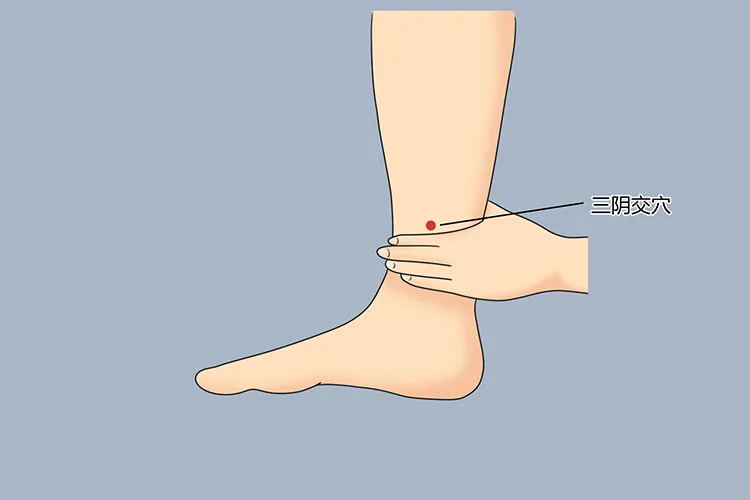
SP6 is located on the inner lower leg, 3 cun (about four finger-widths) above the tip of the inner ankle, on the posterior border of the tibia (shinbone). To find it, measure four finger-widths up from the high point of the inner ankle bone and press just behind the shinbone — the point often feels tender.
Three quick confirmations you have the right spot: (1) it sits just behind the sharp edge of the shinbone, in the flesh toward the back of the leg; (2) pressing it produces a deep, dull ache that may travel down toward the ankle or up the calf; (3) the point is tender right where your inner calf starts to thicken above the ankle.
When to Use SP6 (and When Not)
Use it when
- • You have menstrual cramps or an irregular cycle
- • You struggle to fall asleep or wake during the night
- • You feel bloated, heavy, or puffy — especially in the evening
- • Digestion feels sluggish or your appetite is off
Hold off if
- • You are pregnant — SP6 is a traditional contraindicated point
- • You recently injured the inner ankle, shin, or lower leg
- • There is bruising, swelling, or broken skin over the point
- • You have significant varicose veins right over the point
Use the Hold off column as a safety filter: SP6 is a comfort practice for cramps, sleep, and digestion, not a substitute for gynecological or medical care.
What Are the Benefits?
- Women's health: SP6 regulates the menstrual cycle, eases menstrual cramps, and supports reproductive health.
- Insomnia: It promotes deep, restful sleep and is especially helpful for those who wake frequently during the night.
- Fluid retention: SP6 helps with bloating, puffiness, and water retention, and may ease cold feet and leg swelling.
- Digestive health: It helps with bloating, gas, and poor appetite related to Spleen Qi deficiency.
- Stress and mood: SP6 calms the mind and helps regulate mood swings associated with PMS.
How Do You Use This Point?
Use moderate pressure with your thumb, pressing just behind the shinbone. Favor lighter pressure with a longer duration if the point feels tender, and work in slowly so the ache stays deep and spreading rather than sharp.
Step-by-step technique
- Sit with your leg resting comfortably on a chair or sofa.
- Place your thumb on the SP6 point on one leg, just behind the shinbone.
- Apply firm, steady pressure using small circular motions.
- Hold for 30–60 seconds (up to 90 seconds before bed) while breathing deeply.
- Release slowly, switch legs, and repeat once or twice daily as needed.
Common mistake to avoid: pressing on the sharp edge of the shinbone instead of the flesh behind it, which is painful and misses the point. Slide your thumb to the back of the bone into the calf muscle — the target sensation is a deep, dull, spreading ache, never a bone-edge pinch.
Combine SP6 with These Points
SP6 is at its most powerful in combination. Pick the row closest to your situation and work the points in the order shown, 30–60 seconds each.
| Goal / symptom | Routine (in order) |
|---|---|
| Menstrual cramps | SP6 → ST36 → CV4, 30–60s each, daily from a few days before the period |
| Insomnia | SP6 → HT7 → ST36, holding each 60s before bed |
| Digestion and bloating | SP6 → ST36 → LI4, 30–60s each, after meals |
| Swelling / fluid retention | SP6 → ST36 → KI1, then elevate the legs |
For menstrual cramps, see our acupressure for menstrual cramps guide. For a fuller program, see our acupressure for sleep page and the leg acupressure points body guide. SP6 is also used for weight and fertility support: see our weight loss and fertility guides.
What to Expect
First session (today)
SP6 is often tender, and pressing it usually brings a deep, releasing ache within a minute. For cramps, relief may come fairly quickly; for sleep and cycle regularity, single sessions do little — that takes consistency.
Days 3–7 (consistent daily practice)
With 1–2 sessions per day, falling asleep often feels easier and menstrual symptoms in the next cycle may be milder. This matches the pattern in studies of acupressure for dysmenorrhea and sleep, where benefits appear after several days of regular use.
Weeks 2–4
For cycle regularity, work SP6 across a full cycle rather than only during symptoms — and note that acupressure is a complement, not a replacement. If periods stay severely painful, irregular, or come with heavy bleeding, see a gynecologist.
What Does the Research Say?
Evidence on acupressure for menstrual pain, sleep, and digestive complaints has grown in recent years. Systematic reviews and randomized controlled trials have examined acupressure as an adjunct for these conditions, with results that are generally promising but limited in quality. Meta-analyses of acupressure for dysmenorrhea tend to show a positive direction of effect, though many of the included studies are small and their methodological quality varies considerably.
Researchers consistently note that acupressure trials are hard to blind, because the treatment is physical and participants can usually tell whether they are being treated. This makes it difficult to separate the specific effects of a particular point from the general benefits of touch, pressure, and relaxation. The overall picture — which we discuss in detail on our does acupressure work? review — is one of encouraging signals alongside a clear need for larger, higher-quality studies before firm conclusions can be drawn. For sleep and stress, our acupressure for sleep page summarizes the strongest available evidence.
Acupressure has been evaluated in clinical trials for pain, nausea, anxiety, and sleep, with evidence described as promising but requiring further high-quality research.
— Chen YW, Wang HH. Pain Management Nursing. 2014;15(2):539-550. PMID 23415783.
Verifiable sources
- Chen YW, Wang HH. The effectiveness of acupressure on relieving pain: a systematic review. Pain Management Nursing. 2014;15(2):539-550. PMID 23415783 · DOI
- Liao CC, Liao KR, Lin CL, Li JM. Effects of acupressure on sleep quality and psychological distress in nursing home residents: a randomized controlled trial. Journal of the American Medical Directors Association. 2020;21(12):1958-1965. PMID 32409141
The reviews above evaluated acupressure for pain (including menstrual pain) and for sleep, the two uses of SP6. Neither is a study of SP6 in isolation.
Are There Safety Concerns?
- Avoid during pregnancy: SP6 is a traditional contraindicated point — stimulation may trigger uterine contractions.
- Avoid if you have a recent injury to the inner ankle, shin, or lower leg.
- Do not massage over varicose veins, wounds, rashes, or swelling on the lower leg.
- Use gentle pressure if you have diabetes or poor circulation in the legs.
Red Flags — See a Professional
Stop self-treatment and see a doctor or gynecologist if you notice any of the following:
- Period pain that is severe, worsening, or not relieved by usual measures
- Missed periods, or cycle changes that are new and unexplained
- Heavy bleeding, bleeding between periods, or bleeding after menopause
- A painful, swollen, red, or warm calf, which can signal a blood clot and needs urgent evaluation
- Sleep problems that persist beyond a few weeks or come with low mood, fatigue, or other symptoms