KI1 (Yongquan) — Gushing Spring
KI1, known as Yongquan or Gushing Spring, is the first point of the Kidney meridian, sitting in the deepest hollow of the sole of the foot. It is the classic go-to point when you need to calm anxiety, quiet a racing mind before bed, or feel grounded again after a stressful day.
At a Glance
| Meridian | Kidney (KI) |
|---|---|
| Body region | Sole of the foot, in the deepest hollow of the ball of the foot |
| Best for | Anxiety, insomnia, calming and grounding, hot flashes, blood-pressure support |
| Difficulty | Easy — reachable barefoot, or with a golf or massage ball |
| Hold time | 60–90 seconds per foot |
| Frequency | 1–3 times daily |
| Pairs well with | HT7 (Shenmen), SP6 (Sanyinjiao), CV4 (Guanyuan) |
| Skip if | Open wound, broken skin, or athlete's foot on the sole; history of deep vein thrombosis (see Precautions) |
Why KI1 Matters
KI1 is often described as the most grounding point in the body, and it is the point most requested in routines for anxiety, insomnia, and stress. Because it sits on the sole, it is easy to reach barefoot — no tools, no special posture required — which makes it a realistic daily habit rather than a "someday" remedy. In traditional Chinese medicine, KI1 draws excess Yang energy downward and away from the head, cooling the mind and calming racing thoughts.
The Kidney meridian is linked to the calm Yin energy that supports restful sleep, so slow, gentle pressure on KI1 with even breathing can feel genuinely settling. That same downward, cooling action is why the point is also a traditional stop for hot flashes and night sweats, and why it appears in self-care protocols as a relaxation aid alongside professional care for blood pressure. It is a comfort practice, not a cure — but as a way to press the reset button on a wired nervous system, it is hard to beat.
Where Is This Point Located?
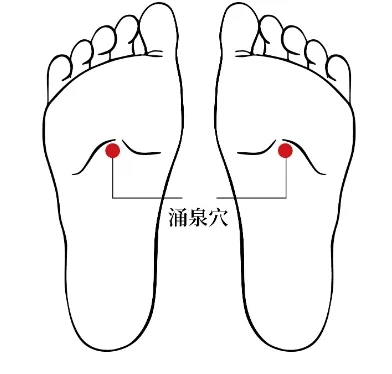
KI1 is on the sole of the foot, roughly one-third of the way from the base of the toes toward the heel, in the hollow that forms between the second and third metatarsal bones when you point the foot. The most reliable landmark: curl your toes under — KI1 sits in the deepest dimple that appears on the ball of the foot at the front of the arch.
Three quick confirmations you have the right spot: (1) it is the deepest, softest hollow on the sole, right where the ball of the foot meets the arch; (2) pressing it produces a distinctly tender, sometimes achy sensation, more so than the surrounding sole; (3) after holding pressure, you often feel a spreading sense of warmth or calm that is hard to confuse with pressing anywhere else on the foot.
When to Use KI1 (and When Not)
Use it when
- • Your mind is racing and you cannot settle, especially at bedtime
- • You feel anxious, restless, or ungrounded during the day
- • You want a calming support alongside blood-pressure or hot-flash care
- • You need a quick reset at your desk or after a stressful event
Hold off if
- • There is a wound, cut, blister, or athlete's foot with broken skin on the sole
- • You have a history of deep vein thrombosis in the leg
- • You have reduced sensation in the foot (for example, diabetic neuropathy)
- • Pressure causes sharp pain rather than a deep, achy sensation
Use the Hold off column as a safety filter: KI1 is a relaxation practice for chronic stress and sleep trouble, not a treatment for acute foot problems or a substitute for blood-pressure medication.
What Are the Benefits?
- Calming and grounding: KI1 draws energy downward, making it excellent for anxiety, restlessness, and feeling ungrounded.
- Insomnia: It promotes deep sleep by calming the mind and settling the spirit.
- Blood-pressure support: Regular, gentle stimulation promotes whole-body relaxation, which supports blood-pressure management as part of a doctor-led plan.
- Hot flashes: KI1 helps cool the body and is a traditional point for night sweats and menopausal hot flashes.
- Headaches: It can relieve headaches that come with a sensation of pressure or heat rushing upward.
How Do You Use This Point?
The sole can take firmer pressure than the ankle or wrist, so you can press with confidence — just build pressure slowly and keep your breathing even. If bending to reach your own foot is awkward, sit with your ankle crossed over the opposite knee, or roll a golf ball under the ball of the foot for a few slow passes.
Step-by-step technique
- Sit comfortably and place one foot on your opposite thigh, or cross the ankle over the knee.
- Curl the toes under and find the deepest dimple on the ball of the foot — that is KI1.
- Use your thumb to apply firm, steady pressure in a slow circular motion.
- Hold for 60–90 seconds per foot while breathing slowly and evenly.
- Release gradually, then repeat on the other foot — ideal before bed or during a stressful moment.
Common mistake to avoid: pressing too hard, too fast. The goal is a deep, dull, spreading ache — not sharp pain or bruising. If you use a golf ball, keep it to gentle rolls and stop if the sole feels bruised the next day.
Combine KI1 with These Points
A full calming routine works better than pressing one point. Pick the row closest to your situation and work the points in the order shown, 60–90 seconds each.
| Goal / symptom | Routine (in order) |
|---|---|
| Trouble falling asleep | KI1 → HT7 → SP6, 60–90s each, as a nightly bedtime wind-down |
| Daytime anxiety and restlessness | KI1 → SP6 → Yintang, 60s each, 1–2 times daily |
| Hot flashes and night sweats | KI1 → SP6 → CV4 (Guanyuan), 90s each, morning and evening |
| Stress reset at the desk | KI1 (rolled with a golf ball under the desk) + HT7, 60s per foot, once at midday |
For a fuller program, see the foot acupressure points body guide and our acupressure for anxiety page.
What to Expect
First session (today)
KI1 is usually noticeably tender on first press. Most people feel a quick sense of calm or "groundedness" within a few minutes — the shoulders drop, breathing slows. The effect can fade as the day goes on, so treat the first session as a taste, not a cure.
Days 3–7 (consistent daily practice)
With 1–2 sessions per day, the tenderness at the point usually eases and falling asleep often feels easier. This matches the pattern in studies of acupressure for insomnia and anxiety, where benefits appear after several days of regular use rather than a single session.
Weeks 2–4
For chronic anxiety or long-standing sleep trouble, KI1 works best as part of a consistent bedtime and stress routine alongside your broader plan. If there is no change after 2–3 weeks, or if sleep and anxiety are disrupting your day, that is a signal to see a clinician rather than press harder.
What Does the Research Say?
Evidence on acupressure for anxiety, sleep, and stress has grown in recent years. Systematic reviews and randomized controlled trials have examined acupressure as an adjunct for these conditions, with results that are generally promising but limited in quality. Meta-analyses of acupressure for sleep and anxiety tend to show a positive direction of effect, though many of the included studies are small and their methodological quality varies considerably.
Researchers consistently note that acupressure trials are hard to blind, because the treatment is physical and participants can usually tell whether they are being treated. This makes it difficult to separate the specific effects of a particular point such as KI1 from the general benefits of touch, pressure, and relaxation. The overall picture — which we discuss in detail on our does acupressure work? review — is one of encouraging signals alongside a clear need for larger, higher-quality studies before firm conclusions can be drawn. For sleep specifically, our acupressure for sleep page summarizes the strongest available evidence.
Acupressure has been evaluated in clinical trials for pain, nausea, anxiety, and sleep, with evidence described as promising but requiring further high-quality research.
— Liao CC, Liao KR, Lin CL, Li JM. Journal of the American Medical Directors Association. 2020;21(12):1958-1965. PMID 32409141.
Verifiable sources
- Liao CC, Liao KR, Lin CL, Li JM. Effects of acupressure on sleep quality and psychological distress in nursing home residents: a randomized controlled trial. Journal of the American Medical Directors Association. 2020;21(12):1958-1965. PMID 32409141
- Chen HM, Wang HH, Chiu MH, Hu HM. Effects of acupressure on anxiety: a systematic review and meta-analysis. Journal of Alternative and Complementary Medicine. 2022;28(5):514-524. PMID 35235358
The trials and reviews above evaluated acupressure for sleep and anxiety, the two uses of KI1. Neither is a study of KI1 in isolation.
Are There Safety Concerns?
- Do not press on the sole if there is a wound, cut, blister, or athlete's foot with broken skin.
- Avoid if you have a history of deep vein thrombosis in the leg — foot massage can be risky in this situation.
- Use extra caution (or skip the point) if you have reduced sensation in the feet, such as diabetic neuropathy.
- Stop if you feel sharp pain, or if the sole stays sore or bruised after the session.
Red Flags — See a Professional
Stop self-treatment and see a doctor if you notice any of the following:
- Swelling, warmth, or pain in one calf or leg that could suggest a blood clot
- Severe headache, chest pain, or dizziness accompanying high blood pressure — treat as an emergency
- A foot wound that is not healing, or redness and warmth spreading from the sole
- Insomnia that persists after 2–3 weeks of regular practice, especially with loud snoring or breathing pauses at night
- Anxiety or panic that is interfering with work, sleep, or daily life