HT7 (Shenmen) — Spirit Gate
HT7, known as Shenmen or Spirit Gate, is the source point of the Heart meridian, sitting at the wrist crease on the little-finger side. It is the classic point for calming a racing mind before bed, easing anxiety, and steadying a heart that flutters under stress.
At a Glance
| Meridian | Heart (HT) |
|---|---|
| Body region | Wrist crease, on the little-finger side, in the hollow just inside the ulnar wrist tendon |
| Best for | Insomnia, anxiety, palpitations, and a racing or fluttering heart under stress |
| Difficulty | Very easy — press the wrist with your opposite thumb anytime |
| Hold time | 60–90 seconds per wrist for sleep; 30–60 seconds for a quick calm |
| Frequency | Nightly, or as needed during anxious moments |
| Pairs well with | Yintang, KI1 (Yongquan), SP6 (Sanyinjiao) |
| Skip if | Recent wrist injury or broken skin over the point (see Precautions) |
Why HT7 Matters
HT7 is the master point for calming the mind in traditional Chinese medicine. Its name, Shenmen, translates to "Spirit Gate" — the gateway through which the spirit settles — and it is the classic target in routines for insomnia, anxiety, and heart-centered calm. When the Heart lacks sufficient blood or Yin nourishment, the Shen cannot settle at night, producing racing thoughts and restless sleep; HT7 is understood to restore that nourishment.
Practically, HT7 is one of the easiest points on the body to use: it sits at the wrist crease, reachable with your opposite thumb at a desk, in bed, or on a plane. It is considered the single most important point for insomnia in traditional practice — effective for both difficulty falling asleep and waking in the night — and it is a common first choice whenever stress makes the heart feel like it is beating out of rhythm.
Where Is This Point Located?
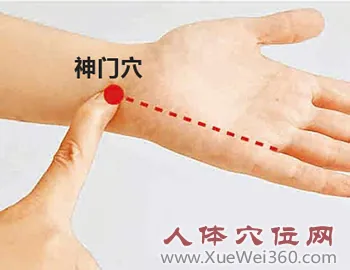
HT7 is located on the inner wrist, on the ulnar (little-finger) side, at the proximal wrist crease. Rest your arm palm-up and bend the wrist slightly — you will see a prominent tendon on the little-finger side. HT7 sits in the small hollow just inside (toward the thumb side, the radial side) of that tendon, in line with the little finger, at the crease.
Three quick confirmations you have the right spot: (1) it is the soft depression at the wrist crease, just inside the prominent tendon on the little-finger side; (2) it is distinctly tender when pressed, more than the surrounding wrist; (3) pressing it produces a deep, achy sensation rather than the sharp pinch you feel if you press the bone or nerve directly.
When to Use HT7 (and When Not)
Use it when
- • Your mind races and you cannot settle into sleep
- • You feel anxious, nervous, or keyed up during the day
- • Your heart flutters, races, or pounds in stressful moments
- • You want a discreet, reachable point for a quick calm anytime
Hold off if
- • You recently injured the wrist or have a wrist fracture
- • The skin over the point is broken, cut, or has a rash
- • The wrist is swollen, warm, or acutely painful
- • Palpitations come with chest pain, breathlessness, or fainting — treat as an emergency
Use the Hold off column as a safety filter: HT7 is a comfort practice for stress and sleep, not a treatment for heart conditions. Palpitations with chest pain, breathlessness, or fainting need emergency care.
What Are the Benefits?
- Insomnia: HT7 promotes restful sleep and helps quiet a racing mind at bedtime.
- Anxiety: It reduces feelings of anxiety, nervousness, and panic.
- Heart palpitations: HT7 helps calm palpitations and heart flutter linked to stress.
- Emotional regulation: It stabilizes mood swings, irritability, and emotional sensitivity.
- Mental calm: HT7 supports focus and a settled mind by calming the spirit.
How Do You Use This Point?
This point is often tender in people with chronic insomnia or stress, so favor lighter pressure with a longer hold. For sleep, hold 60–90 seconds per wrist in a quiet, dim space; for a quick daytime calm, 30–60 seconds is plenty.
Step-by-step technique
- Turn your hand so your palm faces upward.
- Place the thumb of your opposite hand on the HT7 point at the wrist crease, little-finger side.
- Apply gentle to moderate pressure in a small circular motion.
- Hold for 30–90 seconds, breathing slowly and deeply.
- Repeat on the other wrist as needed, especially before sleep.
Common mistake to avoid: pressing the nerve or the bone rather than the soft hollow. If you feel a sharp, electric zing down the palm or fingers, you are off the point — shift slightly and ease the pressure. The target is a deep, dull, achy calm, not a zap.
Combine HT7 with These Points
A full calming routine works better than pressing one point. Pick the row closest to your situation and work the points in the order shown, 60–90 seconds each.
| Goal / symptom | Routine (in order) |
|---|---|
| Falling asleep | HT7 → Yintang → KI1, 60–90s each, in bed with the lights low |
| Waking in the night | HT7 (60s per wrist) → Yintang, staying in bed, no screens, before resettling |
| Anxiety and a racing mind | HT7 → SP6 → KI1, 60s each, 1–2 times daily |
| Stress-related palpitations | HT7 → PC6 (Neiguan), slow deep breaths; seek urgent care if chest pain, breathlessness, or fainting occurs |
For a fuller program, see the hand acupressure chart and our acupressure for sleep and acupressure for anxiety pages.
What to Expect
First session (today)
HT7 is usually tender, and the deep, achy sensation can be surprising. Most people feel noticeably calmer within a few minutes of slow pressure — shoulders drop, breathing steadies. Do not expect perfect sleep on night one; the first session is mostly about learning the spot.
Days 3–7 (consistent nightly practice)
With a nightly routine, the tenderness usually eases and falling asleep often feels easier. This matches the pattern in studies of acupressure for insomnia and anxiety, where benefits tend to appear after several days of regular use rather than a single session.
Weeks 2–4
For chronic insomnia, HT7 works best as part of a full sleep routine — consistent bedtimes, dim light, and no screens. If sleep has not improved after 2–3 weeks, or if palpitations are frequent, see a clinician. Chest pain, breathlessness, or fainting with palpitations is an emergency, not a cue to press harder.
What Does the Research Say?
Evidence on acupressure for insomnia and anxiety has grown in recent years. Systematic reviews and randomized controlled trials have examined acupressure as an adjunct for these conditions, with results that are generally promising but limited in quality. Meta-analyses of acupressure for sleep and anxiety tend to show a positive direction of effect, though many of the included studies are small and their methodological quality varies considerably.
Researchers consistently note that acupressure trials are hard to blind, because the treatment is physical and participants can usually tell whether they are being treated. This makes it difficult to separate the specific effects of a particular point such as HT7 from the general benefits of touch, pressure, and relaxation. The overall picture — which we discuss in detail on our does acupressure work? review — is one of encouraging signals alongside a clear need for larger, higher-quality studies before firm conclusions can be drawn. For sleep and anxiety specifically, our acupressure for sleep page and acupressure for anxiety page summarize the strongest available evidence.
Acupressure has been evaluated in clinical trials for pain, nausea, anxiety, and sleep, with evidence described as promising but requiring further high-quality research.
— Liao CC, Liao KR, Lin CL, Li JM. Journal of the American Medical Directors Association. 2020;21(12):1958-1965. PMID 32409141.
Verifiable sources
- Liao CC, Liao KR, Lin CL, Li JM. Effects of acupressure on sleep quality and psychological distress in nursing home residents: a randomized controlled trial. Journal of the American Medical Directors Association. 2020;21(12):1958-1965. PMID 32409141
- Chen HM, Wang HH, Chiu MH, Hu HM. Effects of acupressure on anxiety: a systematic review and meta-analysis. Journal of Alternative and Complementary Medicine. 2022;28(5):514-524. PMID 35235358
The trials and reviews above evaluated acupressure for sleep and anxiety, the two uses of HT7. Neither is a study of HT7 in isolation.
Are There Safety Concerns?
- Avoid if you recently injured the wrist or have a wrist fracture.
- Do not press over broken skin, cuts, rashes, or blisters on the wrist.
- Use gentle pressure — the wrist contains sensitive nerves and blood vessels.
- Stop if you feel numbness or tingling in the hand or fingers.
- See a doctor (or emergency care) if palpitations come with chest pain, breathlessness, or fainting.
Red Flags — See a Professional
Stop self-treatment and see a doctor if you notice any of the following:
- Palpitations together with chest pain, breathlessness, or fainting — call for emergency help
- A resting heart that races, flutters, or skips beats frequently
- Insomnia that persists after 2–3 weeks, especially with loud snoring or breathing pauses
- Anxiety or panic that is interfering with work, sleep, or daily life
- Wrist pain, swelling, or numbness that appears suddenly or after an injury
Frequently Asked Questions
Where is HT7 and how do I find it?
How long and how often should I press HT7?
Is HT7 effective for both falling and staying asleep?
Can I press HT7 at work or in public?
Why does pressing HT7 help with anxiety and palpitations?
When should I see a doctor instead of using HT7?
Related guides: acupressure for stress relief and sleep, and high blood pressure (support only).