LI4 (Hegu) — Union Valley
LI4, also known as Hegu or Union Valley, is one of the most widely used acupressure points on the body. Located on the hand, it serves as a powerful master point for the head and face — headache, toothache, facial pain, nasal congestion, and immune support.
At a Glance
| Meridian | Large Intestine (LI) |
|---|---|
| Body region | Back of the hand, in the web between thumb and index finger, at the highest point of the muscle bulge |
| Best for | Headache, toothache, facial pain, sinus and nasal congestion, immune support, stress-related tension |
| Difficulty | Easy — the most accessible point on the body |
| Hold time | 30–60 seconds per hand |
| Frequency | 1–3 times daily, or as needed for acute discomfort |
| Pairs well with | GB20 (Fengchi), LV3 (Taichong), LI11 (Quchi) |
| Skip if | Pregnancy — LI4 may trigger uterine contractions and is the first point to avoid; also skip on broken skin or recent hand injuries |
Why LI4 Matters
In traditional practice, LI4 is frequently called the master point for headache- and toothache-type discomfort, and the most important point for head and face pain on the body. Because it sits in the fleshy web between the thumb and index finger, it is one of the easiest points to reach during a busy day.
In traditional Chinese medicine, LI4 regulates the flow of qi through the face and head. Most headaches are understood as qi and blood stagnation in the head region, and LI4 restores smooth flow to relieve it. It is especially used for frontal headaches, tension headaches, and sinus pressure, and it is a key point for toothache and facial pain.
Where Is This Point Located?
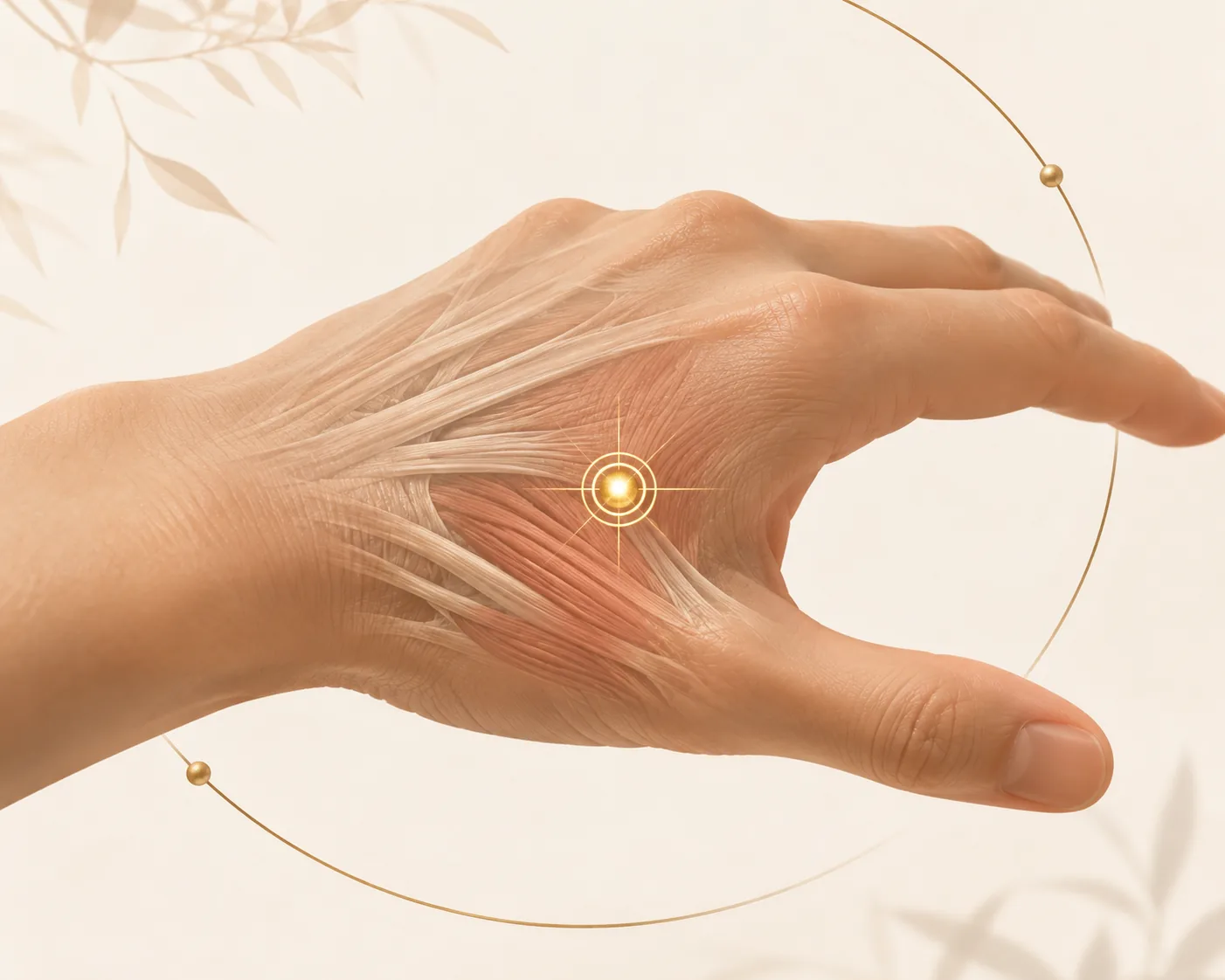
LI4 is located on the back of the hand in the web between the thumb and index finger. To find it, squeeze your thumb against your index finger — the point is at the highest point of the muscle bulge, about at the midpoint of the second metacarpal bone. That tenderness is the reliable landmark.
Three quick confirmations you have the right spot: (1) it is the highest point of the muscle bulge when you press your thumb toward your index finger, not the skin crease or the bone; (2) pressing it produces a deep, dull, spreading ache; (3) a sharp, electric jolt means you are on a nerve — reposition before continuing.
When to Use LI4 (and When Not)
Use it when
- • You feel a headache or tension building, especially in the front of the head
- • You have toothache, facial pain, or jaw tension
- • Your nose is stuffed or your sinuses feel congested
- • You want a daily immune-maintenance point at the first sign of a cold
Hold off if
- • You are pregnant — LI4 is the first point to avoid, in any trimester, as it may trigger contractions
- • There is a cut, wound, or skin infection on the hand
- • You have a recent hand injury, fracture, or surgery in the area
- • Pressure produces a sharp, electric jolt or pins-and-needles sensation
Use the Hold off column as a safety filter: LI4 is a first-line self-care point for everyday pain, but it is also the point with the strongest pregnancy caution on this site.
What Are the Benefits?
- Pain relief: LI4 is one of the most powerful analgesic points, used for headaches, toothaches, facial pain, and tension headaches.
- Immune support: Regular stimulation may help strengthen the immune system and reduce the frequency of colds and flu.
- Sinus and nasal congestion: LI4 helps open the sinuses and relieve stuffiness from allergies and colds.
- Stress and tension: It promotes relaxation and reduces stress-related tension in the neck, jaw, and shoulders.
- Head and face master point: As the traditional master point for the head and face, LI4 is the first point reached for in this region.
How Do You Use This Point?
Pinch the web between your thumb and index finger and press firmly toward the index finger bone. A dull ache radiating along the finger confirms you have found the point.
Step-by-step technique
- Place the thumb of your opposite hand over the LI4 point.
- Apply firm, steady pressure using a small circular motion or a steady push.
- Maintain pressure for 30–60 seconds while breathing deeply.
- Repeat on the other hand. You may feel a dull ache or mild sensation — this is normal.
- For a headache, re-press the point every few minutes until the ache eases.
Common mistake to avoid: pressing so hard, or so close to the bone, that you feel a sharp, electric jolt. The target sensation is a deep, dull, spreading ache — ease off and reposition if it feels sharp or shoots into the fingers. If your thumb tires quickly, the blunt end of a pencil eraser works well as a pressure tool.
Combine LI4 with These Points
A head-and-face routine is more effective than pressing one point. Pick the row closest to your situation and work the points in the order shown, 30–60 seconds each.
| Goal / symptom | Routine (in order) |
|---|---|
| Headache / tension | LI4 → GB20 → LV3, holding each 60s, repeated until the headache eases |
| Toothache / facial pain | LI4 → GB20 → LI11, 60s each; see a dentist if pain persists |
| Nasal congestion / sinus | LI4 → LI20 → GB20, 30–60s each, 1–2 times daily |
| Immune support / cold season | LI4 → LI11 → ST36, once daily as a maintenance routine |
For a complete headache plan, see our acupressure for headache page and the hand acupressure chart for the full hand map. LI4 is also a key point for menstrual cramps and labor support (at term only): see our menstrual cramps and labor guides. LI4 is also used for tinnitus: see our tinnitus guide.
What to Expect
First session (today)
Most people feel relief from a headache or tension within 15–30 minutes of sustained LI4 pressure — it tends to produce the fastest results of any point on the body. If the point feels very tender, ease off a notch; tenderness is common in the fleshy web of the hand.
Days 3–7 (consistent daily practice)
With 1–3 short sessions per day, tension headaches and sinus stuffiness often become less frequent. This matches the pattern in studies of acupressure for headache and facial pain, where benefits appear after several days of regular use.
Weeks 2–4
For chronic headaches, combine LI4 with GB20 and LV3 and address triggers such as posture and stress. Acupressure is a complement, not a replacement — a sudden "worst headache of your life," headache with fever or a stiff neck, or a headache after a head injury requires immediate medical attention.
What Does the Research Say?
Evidence on acupressure for pain has grown in recent years, and LI4 is one of the most-studied points on the body. Systematic reviews and randomized controlled trials have examined acupressure as an adjunct for headache, facial pain, and other pain conditions, with results that are generally promising but limited in quality. Hand points such as LI4 appear frequently in these protocols, and its role as a master point for the head and face is one of the most consistently reported in the clinical literature.
Researchers consistently note that acupressure trials are hard to blind, because the treatment is physical and participants can usually tell whether they are being treated. This makes it difficult to separate the specific effects of a particular point from the general benefits of touch, pressure, and relaxation. The overall picture — which we discuss in detail on our does acupressure work? review — is one of encouraging signals alongside a clear need for larger, higher-quality studies before firm conclusions can be drawn. For headache-specific evidence, see our acupressure for headache guide.
Acupressure has been evaluated in clinical trials for pain, nausea, anxiety, and sleep, with evidence described as promising but requiring further high-quality research.
— Hsieh LL, Liou HH, Lee LH, Chen TH, Yen AM. American Journal of Chinese Medicine. 2010;38(1):1-14. PMID 20128040.
Verifiable sources
- Hsieh LL, Liou HH, Lee LH, Chen TH, Yen AM. Effect of acupressure and trigger points in treating headache: a randomized controlled trial. American Journal of Chinese Medicine. 2010;38(1):1-14. PMID 20128040 · DOI
- Chen YW, Wang HH. The effectiveness of acupressure on relieving pain: a systematic review. Pain Management Nursing. 2014;15(2):539-550. PMID 23415783 · DOI
The trial and review above evaluated acupressure for headache and for pain, the conditions LI4 is most used for. LI4 appears frequently in the protocols they describe, but no study isolates it as a single point.
Are There Safety Concerns?
- Avoid during pregnancy: LI4 is the first point to avoid during pregnancy, in any trimester, as it may induce uterine contractions — do not press it while pregnant.
- Do not apply pressure over broken skin, cuts, scars, or infections on the hand.
- Use gentle pressure on children, the elderly, or those with fragile bones.
- If you experience sharp pain, numbness, or tingling, stop immediately.
Red Flags — See a Professional
Stop self-treatment and see a doctor or dentist if you notice any of the following:
- A sudden, severe "worst headache of your life," or a headache with fever, stiff neck, confusion, or after a head injury
- Facial numbness, weakness, or drooping on one side
- Tooth pain with swelling, fever, or a visibly infected tooth
- Headaches that keep getting worse or interfere with daily life
- Pain that has not improved after 2–3 weeks of regular acupressure