GV20 (Baihui) — Hundred Meetings
GV20, known as Baihui or Hundred Meetings, sits at the very crown of the head. It is traditionally used for headaches, dizziness, mental fatigue, a dip in focus, and the heavy-headed feeling that builds during long days.
At a Glance
| Meridian | Governing Vessel (GV / Du) |
|---|---|
| Body region | Very top of the head, on the midline at the crown |
| Best for | Headaches, dizziness and brain fog, mental fatigue, focus, insomnia |
| Difficulty | Very easy to reach — press the crown with a fingertip or knuckle |
| Hold time | 45–60 seconds |
| Frequency | 1–3 times daily, or whenever focus dips |
| Pairs well with | Yintang, GB20 (Fengchi), HT7 (Shenmen) |
| Skip if | Recent head injury, broken or irritated skin on the scalp, or on an infant's soft fontanelle (see Precautions) |
Why GV20 Matters
GV20 sits at the very top of the head, on the midline, where much of the day's strain collects. Tension headaches, dizziness, eye strain, and mental fatigue all have scalp targets, and the crown is the central hub. Its landmark is simple: the point where an imaginary line between the tips of the ears crosses the midline of the head.
In the traditional model, the scalp carries several yang meridians — the Governing Vessel runs up the midline toward GV20 — and these points regulate the flow of qi toward the head. As a meeting point of all yang channels, GV20 is traditionally used to clear heaviness, refresh the mind, and restore focus. In modern practice it is a favorite study or work point, pressed when concentration dips, and it is often combined with Yintang between the eyebrows and GB20 at the base of the skull for a complete head-and-neck reset. It also features in evening routines for sleep, paired with HT7 when a busy mind will not switch off.
Where Is This Point Located?
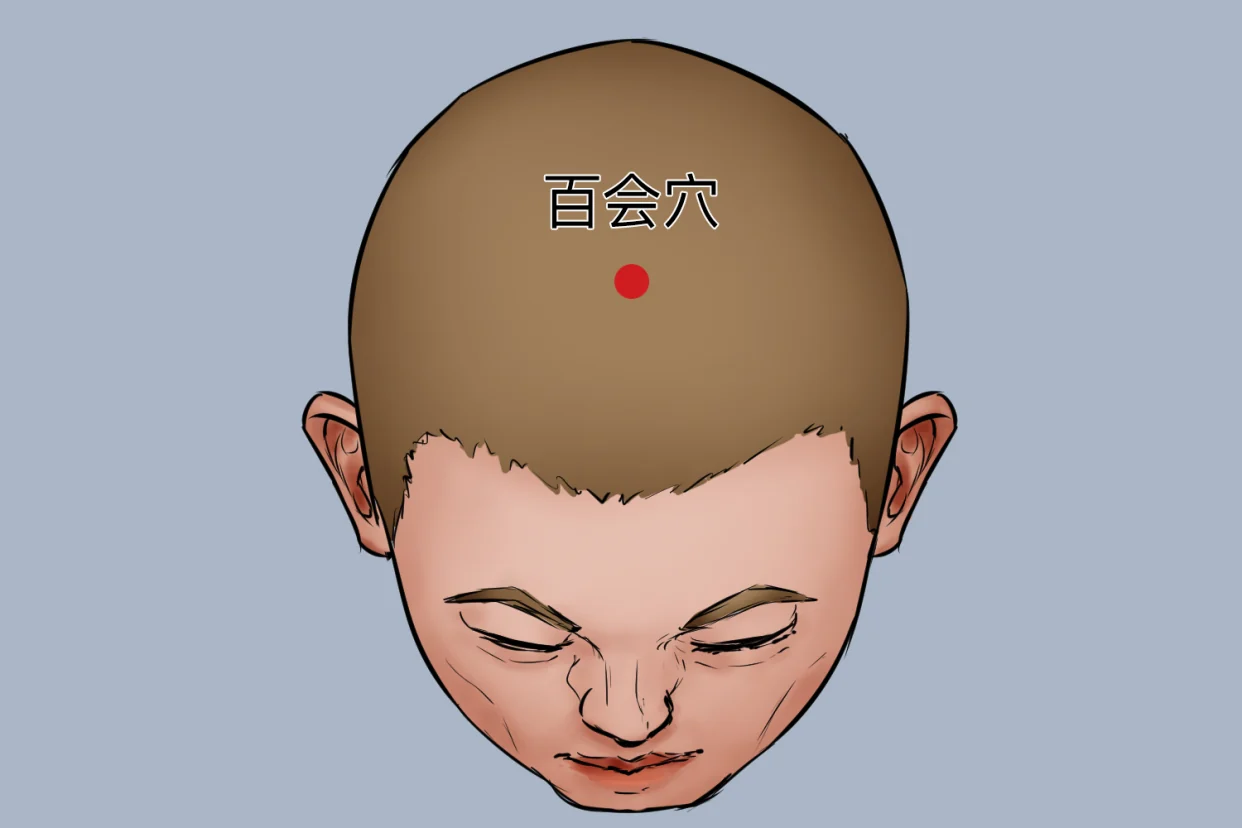
GV20 is on the very top of the head, along the midline, at the crown — about midway between the ears. Find it where an imaginary line drawn from the tip of one ear over the crown to the tip of the other crosses the midline. It lies on the Governing Vessel (Du Mai).
Three quick confirmations you have the right spot: (1) it is exactly on the midline of the head, on the crown; (2) an imaginary line between your ear tips crosses it; (3) pressing straight down produces a deep, dull, full sensation in the scalp — never sharp or on a sore spot.
When to Use GV20 (and When Not)
Use it when
- • A tension headache or heavy-headed feeling builds during the day
- • You feel foggy, unfocused, or mentally fatigued during study or work
- • You feel dizzy or unsteady and need a grounding point
- • Your mind races at night and you want a calming point before bed
Hold off if
- • You recently hit your head or had any head trauma
- • Headache is sudden, severe, or different from your usual pattern
- • There is a cut, rash, or tenderness on the scalp at the crown
- • The person is a baby or infant — never press on the soft fontanelle
Use the Hold off column as a safety filter: GV20 is a comfort practice for ordinary head tension and focus dips, not a response to a head injury or a sudden, severe headache.
What Are the Benefits?
- Headache relief: Traditional point for headaches accompanied by dizziness, brain fog, or a heavy-headed sensation.
- Mental clarity and focus: Clears the head and sharpens focus, especially when concentration dips.
- Dizziness: Classically used for dizziness and a foggy, unsteady head.
- Mental fatigue: Traditionally used to clear heaviness and refresh the mind.
- Sleep support: Used in evening routines, paired with HT7, when a busy mind keeps you awake.
How Do You Use This Point?
Settle into a quiet, upright position and keep pressure gentle on the head. The crown is soft tissue and skin over bone, so firm but kind pressure with the flat of a fingertip works best.
Step-by-step technique
- Place your index finger or knuckle firmly on the crown, on the midline.
- Press at a 90-degree angle, increasing pressure slowly over 10–15 seconds until you feel a deep, dull ache (deqi).
- Breathe evenly and hold for 45–60 seconds, using small circular motions or steady downward pressure.
- Release gradually.
- Repeat as needed — the headache routine closes with 60 seconds on the crown to clear lingering fog.
Common mistake to avoid: pressing hard enough to create tenderness or bruising on the scalp. The target sensation is a deep, dull, spreading fullness — if it feels sharp, or the spot stays sore afterward, use noticeably less force.
Combine GV20 with These Points
A full head-and-reset routine is more effective than pressing one point. Pick the row closest to your situation and work the points in the order shown, 30–60 seconds each.
| Goal / symptom | Routine (in order) |
|---|---|
| Tension headache or heavy head | GV20 → GB20 → Yintang, 60s each, then rest quietly |
| Focus dip during study or work | GV20 → Yintang → LI4, then a 5-minute break away from screens |
| Dizziness or brain fog | GV20 → GB20 → PC6, holding each 60s for up to 3 minutes total |
| Busy mind before sleep | GV20 → HT7 → Yintang in bed, each 30–60s with slow exhales |
For a fuller program, see the head acupressure points body guide, acupressure for headache, and acupressure for sleep.
What to Expect
First session (today)
The crown may feel tender, and most people notice a lighter, clearer-headed feeling within a few minutes. Dizziness and the heavy fog of a long day often ease quickly but can return. Do not expect a cure after one press.
Days 3–7 (consistent daily practice)
With a single midday and evening session, headaches often feel less intense and focus dips become easier to catch early. This matches the pattern in studies of acupressure for headache and tension, where benefits appear after several days of regular use.
Weeks 2–4
For recurring headaches or chronic mental fatigue, keep GV20 as one tool alongside sleep, hydration, and screen breaks. A headache that is sudden, severe, or unlike your usual pattern — or one that has not improved after 2–3 weeks — is a signal to see a clinician.
What Does the Research Say?
Evidence on acupressure for headache, stress, and sleep has grown in recent years. Systematic reviews and randomized controlled trials have examined acupressure as an adjunct for these conditions, with results that are generally promising but limited in quality. Meta-analyses tend to show a positive direction of effect for headache intensity and stress-related symptoms, though many of the included studies are small and their methodological quality varies considerably.
Researchers consistently note that acupressure trials are hard to blind, because the treatment is physical and participants can usually tell whether they are being treated. This makes it difficult to separate the specific effects of a particular point from the general benefits of touch, pressure, and relaxation. The overall picture — which we discuss in detail on our does acupressure work? review — is one of encouraging signals alongside a clear need for larger, higher-quality studies before firm conclusions can be drawn. Within this landscape, treat GV20 as a low-risk self-care tool for head tension and focus, not a proven treatment for migraine or a serious head condition.
Acupressure has been evaluated in clinical trials for pain, nausea, anxiety, and sleep, with evidence described as promising but requiring further high-quality research.
— Liao CC, Liao KR, Lin CL, Li JM. Journal of the American Medical Directors Association. 2020;21(12):1958-1965. PMID 32409141.
Verifiable sources
- Liao CC, Liao KR, Lin CL, Li JM. Effects of acupressure on sleep quality and psychological distress in nursing home residents: a randomized controlled trial. Journal of the American Medical Directors Association. 2020;21(12):1958-1965. PMID 32409141
- Chen HM, Wang HH, Chiu MH, Hu HM. Effects of acupressure on anxiety: a systematic review and meta-analysis. Journal of Alternative and Complementary Medicine. 2022;28(5):514-524. PMID 35235358
The trials and reviews above evaluated acupressure for sleep and anxiety, the two uses of GV20. Neither is a study of GV20 in isolation.
Are There Safety Concerns?
- Keep pressure gentle and target soft tissue rather than bone.
- Never press on the soft fontanelle area of an infant's scalp — this point is for adults and older children only.
- Avoid GV20 after a recent head injury or trauma, and seek medical attention for any new head trauma.
- Do not press through broken or irritated skin; stop if a spot feels sharp rather than achingly full.
- Check with your clinician first if you take blood-thinning medication or have a bleeding disorder.
Red Flags — See a Professional
Stop self-treatment and see a doctor if you notice any of the following:
- A sudden, severe, or "worst headache of your life" feeling
- A headache that follows a recent head injury, fall, or blow to the head
- Headache with fever, stiff neck, confusion, weakness, or difficulty speaking
- Dizziness that is severe, keeps returning, or is accompanied by fainting or hearing loss
- Headaches or dizziness that have not improved after 2–3 weeks of regular practice
Frequently Asked Questions
How do I find GV20?
How long and how often should I press GV20?
Can I press GV20 at work or while studying?
Is GV20 safe during pregnancy?
Does GV20 help with migraine or sleep?
Related guides: acupressure for sinus pressure, migraine, fertility, tinnitus, and high blood pressure (support only).