GB20 (Fengchi) — Wind Pool
GB20, known as Fengchi or Wind Pool, is a Gallbladder meridian point at the base of the skull. It is a primary point for headaches, neck pain, eye strain, nasal congestion, and tension.
At a Glance
| Meridian | Gallbladder (GB) |
|---|---|
| Body region | Base of the skull, in the hollows behind the neck muscles |
| Best for | Headaches, neck pain, eye strain, nasal congestion, tension |
| Difficulty | Easy to reach yourself with both thumbs |
| Hold time | 30–60 seconds per side |
| Frequency | 1–3 times daily |
| Pairs well with | LI4 (Hegu), GB21 (Jianjing), BL10 (Tianzhu) |
| Skip if | Recent injury to the back of the head or neck, or recent head/brain issues (see Precautions) |
Why GB20 Matters
GB20 sits where the base of the skull meets the muscles of the upper neck, one of the most tension-prone junctions in the body. Desk work and everyday stress accumulate here, which is why headaches and neck stiffness often trace back to this spot. Its position on the Gallbladder meridian, which travels up the side of the head, also connects it directly to head symptoms — making it one of the first points reached for when a headache is coming on.
The name Fengchi, meaning Wind Pool, hints at its classical role: in traditional Chinese medicine, GB20 expels "wind," the term behind common colds, headaches, and stiff necks. That is why the same point also appears in routines for sinus congestion, early cold symptoms, and eye strain — it is a genuinely multi-purpose point for the head and upper neck.
Where Is This Point Located?
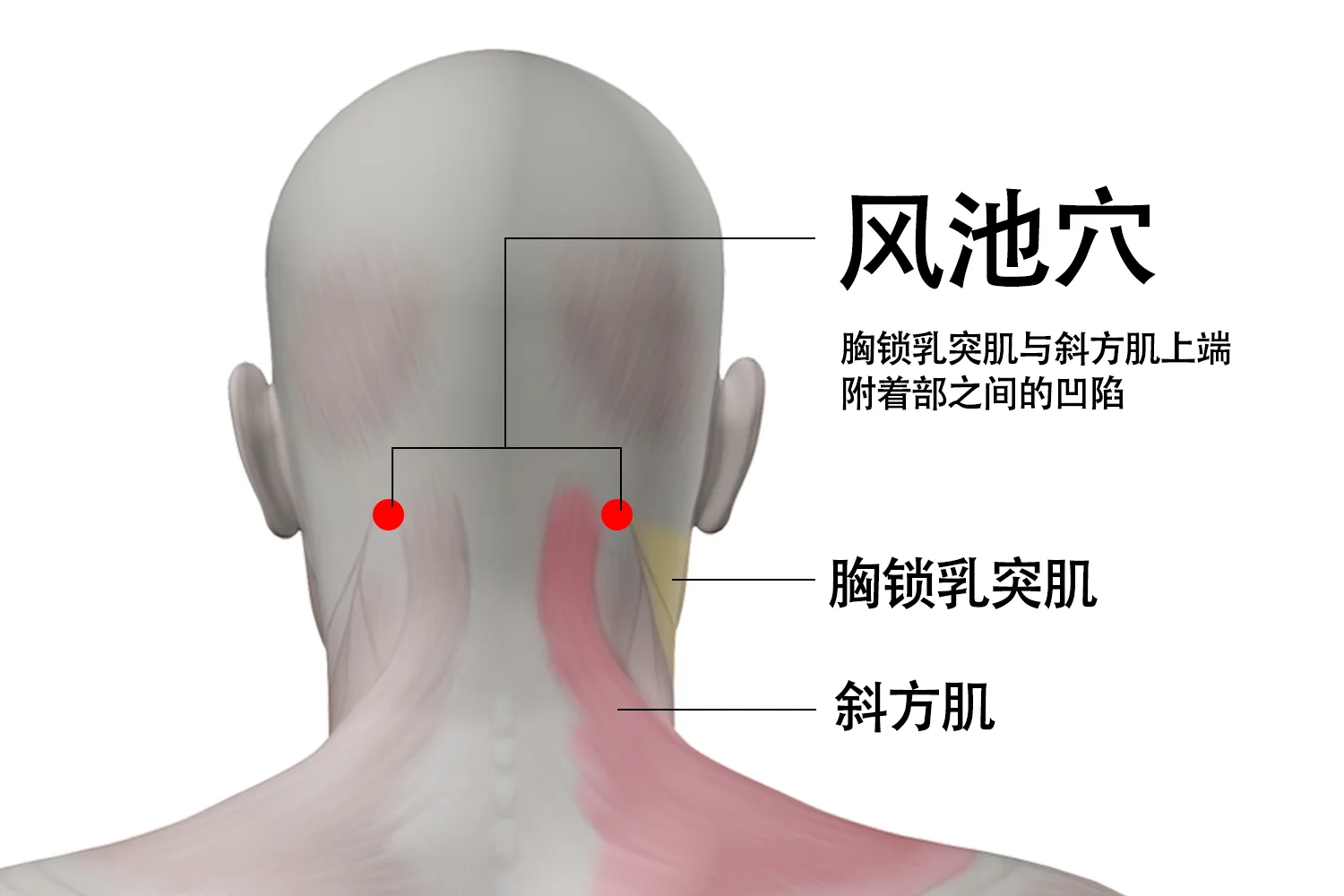
GB20 is in the hollows at the base of the skull, in the depressions just above the posterior hairline (roughly one finger width above it), between the two large neck muscles — the sternocleidomastoid and the trapezius. To find them, slide your fingers up the back of the neck to the skull, then walk them outward into the natural hollows on either side of the spine. Dropping the chin slightly makes them easier to feel.
Three quick confirmations you have the right spot: (1) your thumbs sink into a soft hollow at the base of the skull, not onto bone; (2) pressing upward toward the skull produces a deep, achy sensation that may spread into the head or eye; (3) the hollows sit roughly one thumb-width out from the midline, one on each side.
When to Use GB20 (and When Not)
Use it when
- • A headache is building or you feel tightness at the base of the skull
- • Your neck feels stiff after desk work, driving, or screen time
- • Your eyes feel tired, strained, or achy after long focus
- • You feel congested, stuffy, or like a cold is coming on
Hold off if
- • You recently injured the back of the head or neck, or had a head impact
- • You have had a recent brain-related issue, concussion, or cervical spine problem
- • There is bruising, swelling, or broken skin over the point
- • Pressing causes dizziness, nausea, or sharp pain
Use the Hold off column as a safety filter: GB20 is a comfort practice for tension and congestion, not first aid after a head or neck injury.
What Are the Benefits?
- Headaches and migraines: GB20 is highly effective for tension headaches, migraines, and occipital headaches.
- Neck tension and stiffness: It releases tightness in the neck and upper shoulders, improving range of motion.
- Sinus congestion: GB20 helps relieve sinus pressure and stuffiness associated with allergies and colds.
- Eye strain: It alleviates eye fatigue, blurry vision, and headaches from prolonged screen use.
- Common cold: It is a key point for expelling "wind" in traditional Chinese medicine and easing early cold symptoms.
How Do You Use This Point?
Press upward and slightly inward toward the skull with both thumbs, working in small circles. The area sits close to the brainstem, so pressure should be firm but never forceful — the target is a deep, spreading ache, not pain.
Step-by-step technique
- Sit upright and drop your chin slightly toward your chest.
- Place your thumbs in the hollows at the base of your skull, fingers resting on the top of your head.
- Apply firm upward pressure with your thumbs in small circular motions.
- Hold for 30–60 seconds while breathing deeply, then release gradually.
- Repeat 1–3 times daily, or at the first sign of a headache.
Common mistake to avoid: pressing hard against the bone or on both sides at full force, which can trigger dizziness or nausea. Keep the pressure in the fleshy hollow, work up slowly, and stop immediately if you feel lightheaded or queasy.
Combine GB20 with These Points
GB20 rarely works alone — pairing it with hand and shoulder points covers the whole head-to-shoulder chain. Pick the row closest to your situation and work the points in the order shown, 30–60 seconds each.
| Goal / symptom | Routine (in order) |
|---|---|
| Tension headache | GB20 → GB21 → LI4, 30–60s each, repeat every few hours |
| Neck pain and stiffness | GB20 → BL10 → GB21, holding each 60s, then slow neck rolls |
| Eye strain from screens | GB20 → LI4, holding each 60s, then look away from the screen for 20 seconds |
| Sinus congestion / early cold | GB20 → LI4 → LI11, 30–60s each, 2–3 times daily |
For a fuller program, see the head acupressure points body guide and our acupressure for headache page.
What to Expect
First session (today)
The hollows are usually tender and pressing them often produces a welcome, "melting" release at the base of the skull within a few minutes. A headache that is already building may ease noticeably, though tension can return later in the day.
Days 3–7 (consistent daily practice)
With 1–2 sessions per day, the tenderness at GB20 usually settles and headaches that used to build up during the day may stay away longer. This matches the pattern in studies of acupressure for headache and neck pain, where benefits appear after several days of regular use.
Weeks 2–4
For recurring tension headaches, treat GB20 as part of a broader routine — posture, hydration, sleep, and screen breaks. Acupressure is a complement, not a replacement: if headaches increase in frequency or severity, or are joined by new symptoms, see a clinician.
What Does the Research Say?
Evidence on acupressure for headache and neck pain has grown in recent years. Systematic reviews and randomized controlled trials have examined acupressure as an adjunct for pain conditions, with results that are generally promising but limited in quality. Meta-analyses of acupressure for pain tend to show a positive direction of effect, though many of the included studies are small and their methodological quality varies considerably.
Researchers consistently note that acupressure trials are hard to blind, because the treatment is physical and participants can usually tell whether they are being treated. This makes it difficult to separate the specific effects of a particular point from the general benefits of touch, pressure, and relaxation. The overall picture — which we discuss in detail on our does acupressure work? review — is one of encouraging signals alongside a clear need for larger, higher-quality studies before firm conclusions can be drawn. For headaches and neck tension specifically, our acupressure for headache and acupressure for neck pain pages summarize the strongest available evidence.
Acupressure has been evaluated in clinical trials for pain, nausea, anxiety, and sleep, with evidence described as promising but requiring further high-quality research.
— Hsieh LL, Liou HH, Lee LH, Chen TH, Yen AM. American Journal of Chinese Medicine. 2010;38(1):1-14. PMID 20128040.
Verifiable sources
- Hsieh LL, Liou HH, Lee LH, Chen TH, Yen AM. Effect of acupressure and trigger points in treating headache: a randomized controlled trial. American Journal of Chinese Medicine. 2010;38(1):1-14. PMID 20128040 · DOI
The randomized trial above is the closest direct evidence we cite: it tested acupressure for headache, the condition GB20 is most used for. It did not study GB20 as a single point.
Are There Safety Concerns?
- Use gentle pressure — the base of the skull is sensitive and pressing too hard can cause dizziness.
- Avoid if you have a recent injury to the back of the head or neck, cervical spine instability, or a recent head/brain issue such as a concussion.
- Do not press on both GB20 points simultaneously with extreme force.
- Stop if you feel lightheaded, nauseous, or if pressing triggers sharp pain.
Red Flags — See a Professional
Stop self-treatment and see a doctor if you notice any of the following:
- A sudden, severe "worst headache of your life," or a headache after a head injury
- Neck stiffness with fever, which needs urgent evaluation
- Headache with vision changes, confusion, weakness, or trouble speaking
- Dizziness, unsteadiness, or fainting that comes with neck pressure or movement
- Headaches that are becoming more frequent or more severe despite regular acupressure
Frequently Asked Questions
Where exactly is GB20 and how do I find it?
Why does pressing GB20 help headaches?
How long and how often should I press GB20?
Can I press GB20 while sitting at my desk?
When should I see a doctor instead of pressing GB20?
Related guides: acupressure for sinus pressure, migraine, and tinnitus.