CV4 (Guanyuan) — Gate of Origin
CV4, known as Guanyuan or the Gate of Origin, is one of the most important points on the Conception Vessel. Located on the lower abdomen, it is classically regarded as a reservoir of the body's vital energy and is used for urinary, reproductive, and constitutional support — frequent urination, menstrual irregularity, fatigue, and a general sense of running cold.
At a Glance
| Meridian | Conception Vessel (CV / Ren Mai) |
|---|---|
| Body region | Lower abdomen, on the midline about four of your own finger-widths below the navel |
| Best for | Frequent urination and night waking, menstrual irregularity, painful periods, fatigue, low immunity, lower-abdominal cold |
| Difficulty | Easy to reach lying down; needs light, patient, breath-matched pressure |
| Hold time | 1–2 minutes per session, in slow circles |
| Frequency | 1–3 times daily |
| Pairs well with | ST36 (Zusanli), SP6 (Sanyinjiao), KI1 (Yongquan) |
| Skip if | Pregnancy (especially the first trimester), recent abdominal or pelvic surgery, or within 30 minutes of a full meal |
Why CV4 Matters
CV4 is the front-mu point of the Small Intestine and sits on the Conception Vessel, the midline channel that runs down the front of the body. Its name, Gate of Origin, reflects its traditional role as the place where the body's deepest vital energy, or yuan qi, is said to reside. In traditional Chinese medicine this makes CV4 a foundational point for rebuilding energy after illness, fatigue, or depletion, and it is frequently used for the lower abdomen and pelvic region.
Because it sits low on the abdomen, CV4 is closely linked to the bladder, uterus, and lower intestines in the classical system. Practitioners commonly reach for it for frequent urination, menstrual discomfort, and a general sense of low vitality or feeling cold. In self-care it pairs well with warmth — a warm compress over the point is a classic way to deepen its effect — and with slow, deep breathing to help the body settle into a restful state.
Where Is This Point Located?
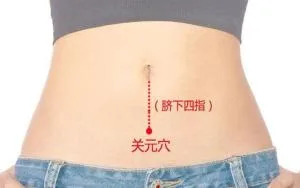
CV4 is on the midline of the lower abdomen, three cun below the center of the belly button. A practical way to measure is to place four of your own fingers horizontally below the navel; the point sits just below the bottom edge of the little finger. For most people this lands roughly halfway between the navel and the top of the pubic bone, in the soft tissue of the lower abdomen. Because finger-width measurement varies from person to person, use your own fingers and adjust to where you feel the point most clearly.
Three quick confirmations you have the right spot: (1) it sits on the exact midline, not off to either side; (2) it is soft tissue, roughly halfway between the navel and the pubic bone; (3) light pressure may produce a mild sense of warmth, fullness, or "pull," but never a sharp pain.
When to Use CV4 (and When Not)
Use it when
- • You wake at night to urinate or urinate more often than usual
- • Menstrual periods are irregular, or cramps are uncomfortable
- • You feel persistently tired or drained and want a daily energy-maintenance point
- • The lower abdomen feels cold, or you generally run cold
Hold off if
- • You are pregnant — especially in the first trimester — unless your provider says otherwise
- • You have had recent abdominal or pelvic surgery
- • The lower abdomen is painful to the touch or the pain is unexplained
- • You have just eaten a full meal (wait at least 30 minutes)
Use the Hold off column as a safety filter: CV4 is a restorative, maintenance point, not first aid — and persistent urinary or pelvic symptoms deserve a medical checkup.
What Are the Benefits?
- Urinary health: Traditionally used for frequent urination, nocturia (waking at night to urinate), and general urinary discomfort.
- Reproductive health: Classically used for menstrual irregularity, painful periods, and premenstrual discomfort.
- Fatigue and low energy: A key point for restoring vitality and supporting recovery from prolonged tiredness.
- Immune support: Traditionally regarded as a point that strengthens the body's defenses and resilience.
- Lower abdominal cold: Used when the lower abdomen feels cold or the person generally runs cold.
How Do You Use This Point?
This point works best when the whole body is relaxed and the abdomen is soft. Lie down, breathe deeply, and keep the pressure slow and patient rather than hard.
Step-by-step technique
- Lie on your back with your knees slightly bent and a cushion under them so the abdomen relaxes.
- Place your middle finger (or the heel of your palm) on CV4, four of your own finger-widths below the belly button on the midline.
- Apply a firm but comfortable pressure and knead in slow circles for 1–2 minutes.
- Match the movement to your breath — press gently on the exhale and ease off on the inhale.
- Finish with a warm compress or heat pack over the point and rest for a few minutes.
Common mistake to avoid: pressing hard into a full bladder, straight after a heavy meal, or with a tensed abdominal wall. CV4 responds to light, breath-matched pressure on a relaxed belly — forcing it only creates discomfort without adding benefit.
Combine CV4 with These Points
A lower-abdominal routine is more effective than pressing one point. Pick the row closest to your situation and work the points in the order shown, 1–2 minutes each, with a warm compress over CV4 at the end.
| Goal / symptom | Routine (in order) |
|---|---|
| Fatigue / low energy | CV4 → ST36 → KI1, 1–2 min each, morning or before rest |
| Menstrual cramps / irregular periods | CV4 → SP6 → ST36, 1 min each, 1–2 times daily around the period |
| Frequent urination / nocturia | CV4 → SP6 → KI1 in the evening, then a warm compress over CV4; see a doctor if symptoms persist |
| Lower-abdominal cold / low immunity | CV4 + ST36 + SP6, 1–2 min each, once daily as a maintenance routine |
For a fuller program, see the abdomen acupressure points body guide and our acupressure for sleep page for a grounding wind-down routine.
What to Expect
First session (today)
The point may feel slightly tender, and most people notice a looser, warmer sensation in the lower abdomen within a few minutes of light circular pressure. Do not expect a change in urinary or menstrual patterns after one session.
Days 3–7 (consistent daily practice)
With 1–2 sessions per day, the abdomen usually feels warmer and more settled, and some people report sleeping a little more deeply and waking feeling less drained. This matches the pattern in studies of acupressure for fatigue and menstrual discomfort, where benefits appear after several days of regular use.
Weeks 2–4
For chronic fatigue or menstrual irregularity, keep CV4 as part of a routine that includes adequate sleep, nutrition, and movement. Acupressure is a complement, not a replacement — and if symptoms such as night waking, heavy periods, or fatigue have not improved after 2–3 weeks, that is a signal to see a clinician.
What Does the Research Say?
Evidence on acupressure for fatigue, menstrual, and urinary complaints has grown in recent years. Systematic reviews and randomized controlled trials have examined acupressure as an adjunct for these conditions, with results that are generally promising but limited in quality. Lower-abdominal and midline points such as CV4 are among the most commonly studied in these protocols, and acupressure at abdominal points is frequently included in research on menstrual discomfort and energy restoration.
Researchers consistently note that acupressure trials are hard to blind, because the treatment is physical and participants can usually tell whether they are being treated. This makes it difficult to separate the specific effects of a particular point from the general benefits of touch, pressure, and relaxation. The overall picture — which we discuss in detail on our does acupressure work? review — is one of encouraging signals alongside a clear need for larger, higher-quality studies before firm conclusions can be drawn.
Acupressure has been evaluated in clinical trials for pain, nausea, anxiety, and sleep, with evidence described as promising but requiring further high-quality research.
— Chen YW, Wang HH. Pain Management Nursing. 2014;15(2):539-550. PMID 23415783.
Verifiable sources
- Chen YW, Wang HH. The effectiveness of acupressure on relieving pain: a systematic review. Pain Management Nursing. 2014;15(2):539-550. PMID 23415783 · DOI
The review above evaluated acupressure for pain, including menstrual and pelvic discomfort where CV4 is traditionally used. It is not a study of CV4 in isolation.
Are There Safety Concerns?
- Avoid strong abdominal pressure during pregnancy — CV4 is traditionally avoided or used only very gently then; consult a midwife or doctor first, especially in the first trimester.
- Do not press within 30 minutes after a full meal, or over a full bladder.
- Do not press if you have had recent abdominal or pelvic surgery.
- Skip the point if there is skin irritation, a rash, or a hernia near the lower abdomen.
- Stop if pressure causes sharp pain or cramping, and seek medical advice for unexplained abdominal pain.
Red Flags — See a Professional
Stop self-treatment and see a doctor if you notice any of the following:
- Unexplained or worsening pain in the lower abdomen or pelvis
- Blood in the urine, or painful or burning urination
- Missed periods with possible pregnancy, or unusually heavy or prolonged bleeding
- A hard or bulging mass felt in the lower abdomen
- Symptoms that have not improved after 2–3 weeks of regular acupressure
Frequently Asked Questions
How do I find CV4 on myself?
How long and how often should I press CV4?
Can CV4 help with frequent urination or night waking?
Is CV4 safe during pregnancy?
When should I see a doctor instead of using CV4?
Related guides: acupressure for menstrual cramps and fertility.