LU7 (Lieque) — Broken Sequence
LU7, known as Lieque or Broken Sequence, is a Lung meridian point traditionally used for the classic "headache with stiff neck" pattern — frontal pain that spreads toward the back of the neck — along with coughs, sore throat, and nasal congestion.
At a Glance
| Meridian | Lung (LU) |
|---|---|
| Body region | Thumb side of the forearm, just above the wrist |
| Best for | Frontal headache with a stiff neck, cough, sore throat, nasal congestion |
| Difficulty | Easy to reach yourself — the crossed-hands trick finds it in seconds |
| Hold time | 30–60 seconds per side |
| Frequency | 1–3 times daily |
| Pairs well with | LI4 (Hegu), GB20 (Fengchi), CV22 (Tiantu) |
| Skip if | Recent wrist injury, sprain, or a fracture in the thumb-side (radial) area (see Precautions) |
Why LU7 Matters
LU7 is the Luo (connecting) point of the Lung meridian and one of the eight confluent points, opening to the Conception (Ren) meridian. Its position on the thumb side of the forearm, just above the wrist, makes it one of the easiest upper-limb points to reach for self-care — you can press it at a desk without removing a jacket or changing position. Because the Lung meridian is classically linked to the head, throat, and upper body, LU7 is a common first choice for headache that begins at the forehead and radiates toward the stiff, tense neck that accompanies it.
LU7 belongs to the same band of arm and wrist points used throughout the site for head and neck complaints, and it is a frequently recommended point for the early stages of a head cold. Applied gently while turning the head, it is also a practical point for people who hold tension in the neck after desk work, screen time, or long commutes. In traditional needle practice LU7 is classically paired with KI6 (Zhaohai), and in self-acupressure the same pairing is used as one of the classic point combinations for throat and neck complaints.
Where Is This Point Located?
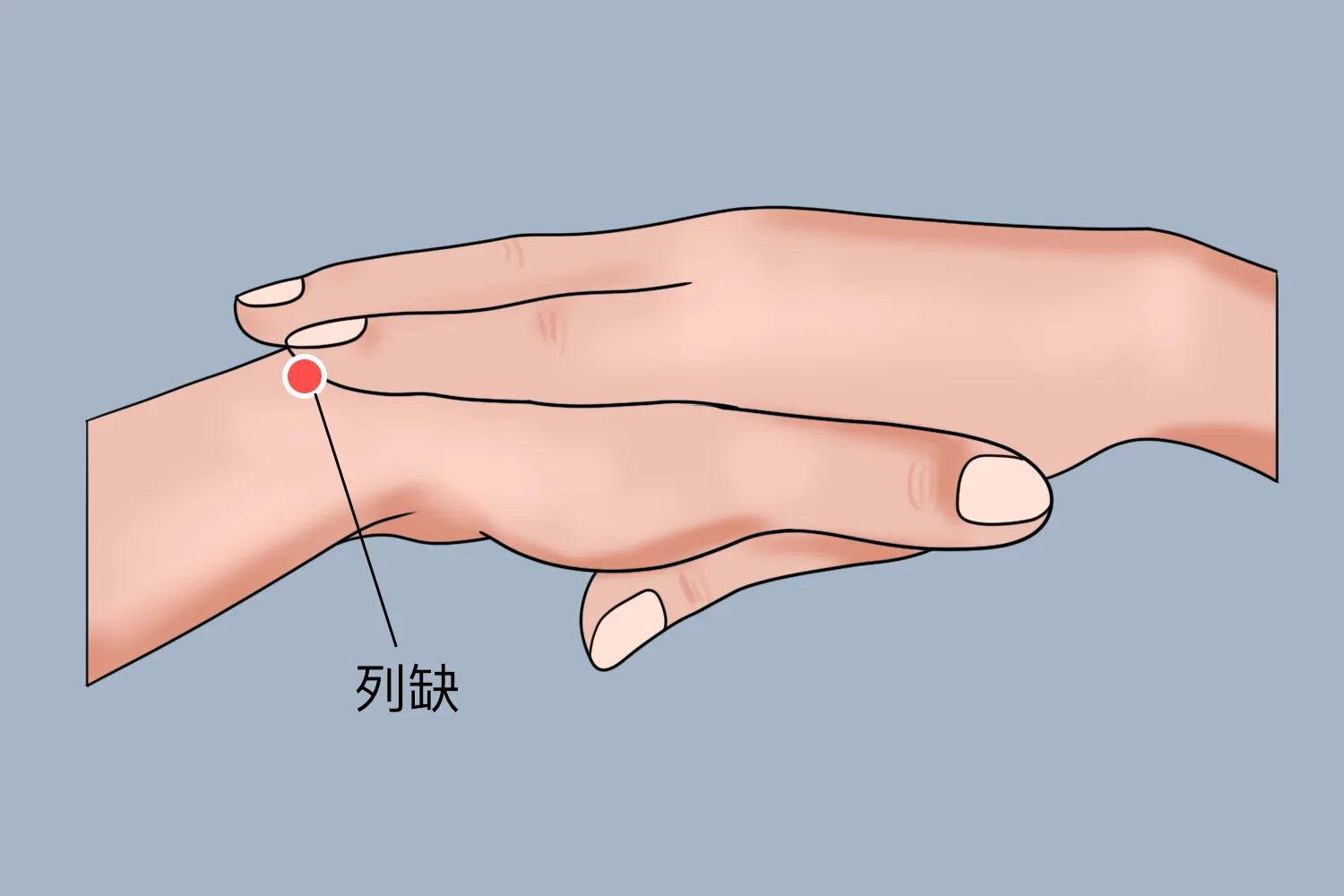
LU7 sits on the radial (thumb) side of the forearm, 1.5 cun above the wrist crease — about the width of two fingers — in the small depression just above the radial styloid process, the bony bump at the outer edge of the wrist. The simplest way to find it: cross the thumb and index finger of both hands, like a handshake made with the forearms crossed, and the tip of your index finger will land on or very near the LU7 point.
Three quick confirmations you have the right spot: (1) it is the hollow on the thumb side of the forearm, not the center of the wrist; (2) pressing toward the bone produces a deep, dull ache that may travel toward the thumb; (3) the depression sits about two finger widths above the wrist crease, and the crossed-hands trick lands your index fingertip on it.
When to Use LU7 (and When Not)
Use it when
- • You have a frontal headache that spreads into a tight, stiff neck
- • Your throat feels scratchy or a cough is building — the first signs of a cold
- • Your nose is congested and you feel stuffed up
- • Your neck is tense after desk work, screen time, or a long commute
Hold off if
- • You recently sprained, fractured, or had surgery on the wrist or forearm
- • There is a cast, swelling, bruising, or broken skin over the point
- • You have numbness or tingling in the thumb or hand
- • The headache is sudden, severe, or comes with fever, vision changes, or vomiting
Use the Hold off column as a safety filter: LU7 is a comfort practice for head-and-neck tension and cold symptoms, not first aid for an acute wrist injury or a sudden severe headache.
What Are the Benefits?
- Headache with neck stiffness: LU7 is the traditional point for frontal headache that radiates into a tense neck — the classic "headache connected to the neck" pattern.
- Cough: It is used for a dry, irritating cough and for tightness in the chest during the early stages of a cold.
- Sore throat: LU7 helps soothe throat irritation and hoarseness, especially when combined with warmth and fluids.
- Nasal congestion: It supports the upper respiratory defenses and is commonly pressed for stuffy or running noses.
- Stiff neck: Pressed gently while rotating the head, LU7 helps loosen a stiff neck after poor sleep or long periods at a desk.
How Do You Use This Point?
Lay the forearm palm-down on a support, press with the opposite thumb toward the bone, and gently rotate the head and neck while holding — this combination is what makes LU7 useful for the headache-with-stiff-neck pattern.
Step-by-step technique
- Rest your forearm on a flat surface with your palm facing down to relax the wrist.
- Place the pad of your opposite thumb in the depression just above the wrist, on the thumb side, against the radial styloid process.
- Press firmly toward the bone until you feel a deep, dull ache that stops short of sharp pain.
- Hold for 30–60 seconds while slowly turning your head from side to side and nodding gently.
- Repeat on both arms, using it at the earliest sign of a frontal headache or head cold.
Common mistake to avoid: pressing the center of the wrist instead of the thumb-side depression, or pressing so hard that you feel a sharp pinch toward the thumb. The target sensation is a deep, dull, spreading ache — ease off if it turns sharp or travels into the hand.
Combine LU7 with These Points
A full head-and-neck routine is more effective than pressing one point. Pick the row closest to your situation and work the points in the order shown, 30–60 seconds each.
| Goal / symptom | Routine (in order) |
|---|---|
| Frontal headache with stiff neck | GB20 → LU7 → LI4, 30–60s each, repeat 1–2 times daily |
| First signs of a cold / scratchy throat | LU7 → CV22 → LI4, gentle holds, plus warmth and fluids |
| Stuffy nose with congestion | LU7 → LI20 → LI4, holding each 30–60s |
| Desk-work neck tension (prevention) | LU7 + GB20 at midday and again before bed; pair with posture breaks every 30–45 minutes |
LU7 sits on the arm and wrist acupressure points body guide. For a fuller program, pair it with the head acupressure points body guide and our acupressure for headache page.
What to Expect
First session (today)
The point is often tender, especially if your neck is already tight. Most people feel the forehead pressure and neck stiffness ease within a few minutes of holding LU7 while turning the head, though symptoms can return as the day goes on. Do not expect a cure after one press.
Days 3–7 (consistent daily practice)
With 1–2 sessions per day, tenderness at the point usually eases and the "headache with stiff neck" pattern becomes less frequent. This matches the pattern in studies of acupressure for tension-type headache, where benefits appear after several days of regular use.
Weeks 2–4
For recurring head and neck tension, keep LU7 in your routine and pair it with the points above. Acupressure is a complement, not a replacement — and a headache pattern that is new, worsening, or accompanied by neurological symptoms needs medical review rather than more pressing.
What Does the Research Say?
Systematic reviews and randomized controlled trials have examined acupressure for headache and pain conditions, with results that are generally promising but limited in quality. Manual stimulation of classic upper-limb points is commonly included in self-care protocols for head and neck tension, and several trials report meaningful reductions in headache intensity and frequency compared with no treatment, even though the overall methodological quality of the evidence is mixed. You can read a fuller assessment of what this evidence does and does not show on our does acupressure work? page.
Point-specific research isolating LU7 on its own is scarce — the strongest findings come from broader studies of acupressure for tension-type headache and migraine. In traditional practice LU7 carries the specific classical indication of headache that connects to a stiff neck, and it is usually trained together with points on the neck and hands. Like most acupressure research, the results should be read as supportive and promising rather than definitive, and they do not replace medical treatment for persistent or severe symptoms.
Acupressure has been evaluated in clinical trials for pain, nausea, anxiety, and sleep, with evidence described as promising but requiring further high-quality research.
— Hsieh LL, Liou HH, Lee LH, Chen TH, Yen AM. American Journal of Chinese Medicine. 2010;38(1):1-14. PMID 20128040.
Verifiable sources
- Hsieh LL, Liou HH, Lee LH, Chen TH, Yen AM. Effect of acupressure and trigger points in treating headache: a randomized controlled trial. American Journal of Chinese Medicine. 2010;38(1):1-14. PMID 20128040 · DOI
- Song HJ, Seo HJ, Lee H, Son H, Choi SM, Lee S. Effect of self-acupressure for symptom management: a systematic review. Complementary Therapies in Medicine. 2015;23(1):68-78. PMID 25637155 · DOI
The reviews above evaluated acupressure for headache and for respiratory complaints, the two uses of LU7. Neither is a study of LU7 in isolation.
Are There Safety Concerns?
- Avoid pressing if you have a recent wrist fracture, sprain, surgery, or a cast on that arm.
- Do not apply pressure over broken skin, a rash, a wart, or a bruise on the depression.
- Stop if pressure causes shooting pain, numbness, or tingling that radiates into the thumb or hand.
- Keep pressure light if you have carpal tunnel syndrome or nerve symptoms in the wrist, and stop if symptoms worsen.
Red Flags — See a Professional
Stop self-treatment and see a doctor if you notice any of the following:
- A sudden, severe "worst-ever" headache, especially after a blow to the head
- Headache with fever, a stiff neck, confusion, vision changes, or vomiting
- Cough with blood, high fever, or chest pain
- Weakness or numbness in the hand or arm
- Wrist or neck pain that has not improved after 2–3 weeks of regular acupressure