Taiyang — Sun Point
Taiyang, the Sun point, is one of the most widely used extra points of the head and face. Resting in the hollow of the temple, it is a go-to point for tension headaches, migraines, eye strain and dry eyes, and the facial tightness that builds up during long screen days.
At a Glance
| Meridian | Extra point (not on a meridian) |
|---|---|
| Body region | Temple, one finger width behind the midpoint between the eyebrow tip and outer eye corner |
| Best for | Tension headaches, migraines, eye strain, dry eyes, toothache, facial tension |
| Difficulty | Very easy to find and press — both temples with your own fingers |
| Hold time | 1–2 minutes, gentle pressure |
| Frequency | As needed during screen breaks, or daily for tension relief |
| Pairs well with | GB20 (Fengchi), Yintang, LI4 (Hegu) |
| Skip if | Recent eye surgery, head or face trauma, or broken skin at the temple — and always press gently (see Precautions) |
Why Taiyang Matters
Taiyang is an extra point, which means it does not belong to any of the fourteen meridians — but it is one of the most commonly pressed points on the entire head and face. It sits directly over the temporalis muscle, the fan of muscle on the side of the head that clenches when you grind your teeth, squint at a screen, or hold stress in your jaw. That direct placement is why it responds so reliably to simple finger massage: you can feel the tension that lives in that area release almost immediately.
Because it does not require tracing a meridian path, Taiyang is easy to learn and to apply anytime — at a desk, during a long meeting, or before bed. Together with Yintang and GB20, it anchors our head and face routines for screen fatigue and tension-type headache, and it is often the first point taught to beginners because the position is so obvious once you feel the temple hollow.
Where Is This Point Located?
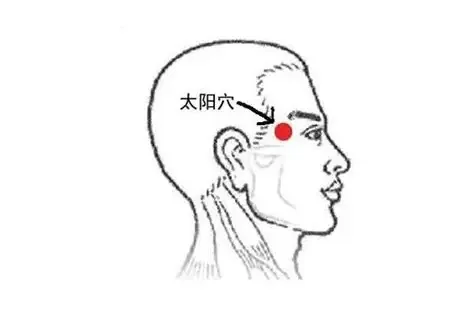
Taiyang lies in the depression at the temple, about one finger width (roughly 1 cun) posterior to the midpoint of the line connecting the outer tip of the eyebrow and the outer corner of the eye (the outer canthus). Close your eyes, rest your index and middle fingers on the temple, and press gently — you will feel a soft hollow between the edge of the eye socket and the temple bone. That hollow is the point.
Three quick confirmations you have the right spot: (1) it is the soft hollow just behind the midpoint between the eyebrow tip and the outer eye corner; (2) light pressure produces a distinctly tender or "wired" sensation that the surrounding skin does not; (3) the tenderness usually tracks your tension level — the point feels more sensitive on stressed, screen-heavy days.
When to Use Taiyang (and When Not)
Use it when
- • A tension headache or migraine is building at the temple
- • Your eyes feel strained, tired, or dry after long screen time
- • Jaw clenching or facial tightness is building up
- • You want a simple wind-down before sleep or during a break
Hold off if
- • You recently had eye surgery, or any head or face trauma
- • The skin at the temple is broken, bruised, or irritated
- • Pressure causes dizziness, blurred vision, or a worsening headache
- • The headache is sudden, severe, or the worst you have ever had
Use the Hold off column as a safety filter: Taiyang is a comfort practice for tension and eye strain, not a treatment for a sudden or severe headache — and pressure here must always stay gentle.
What Are the Benefits?
- Tension headache: Taiyang is a primary point for the band-like pressure headaches that concentrate at the temples, and it is also used for migraine-related head pain.
- Eye strain: It relieves tired, strained eyes, dry eyes, and visual fatigue from computer, phone, or driving use.
- Facial tension: It eases tightness in the temporalis muscle, which helps with jaw clenching and facial stress.
- Toothache: In traditional practice it is used for pain in the upper jaw and face, alongside dental care.
- Relaxation: Slow circular massage at the temples is a simple, effective way to wind down a racing head before sleep.
How Do You Use This Point?
Use the pads of your index and middle fingers, press into the temple hollow with a light-to-moderate touch, and work slow clockwise circles while breathing deeply. The muscle layer here is thin, so gentle pressure goes a long way — more is not better at the temple.
Step-by-step technique
- Sit comfortably with your back supported and close your eyes.
- Place the pads of your index and middle fingers on the hollow of each temple.
- Apply gentle to moderate pressure and make slow, small clockwise circles.
- Breathe deeply for 1–2 minutes, keeping the circles small and the pressure even.
- Ease the pressure gradually, then rest with your eyes closed for a moment before continuing your day.
Common mistake to avoid: pressing hard or fast at the temple. The skin is thin and the area sits close to the eye — the target is a gentle, even, achy relief, not force. If you feel dizzy, see spots, or the headache worsens, stop immediately and seek medical advice.
Combine Taiyang with These Points
A head-and-shoulders routine works better than a single point. Pick the row closest to your situation and work the points in the order shown, 1–2 minutes each, with gentle pressure.
| Goal / symptom | Routine (in order) |
|---|---|
| Tension headache at the temples | Taiyang → GB20 → LI4, 60–90s each, in a quiet space |
| Screen fatigue and eye strain | Taiyang → Yintang, 60s each, during every screen break |
| Migraine-related head pain | GB20 → Taiyang → Yintang, holding each 90s, with a dark, quiet room and fluids |
| Stress and jaw clenching | Taiyang → Yintang → LV3, 60s each, as a nightly wind-down |
For a fuller program, see the face acupressure points and head acupressure points body guides, and our acupressure for migraine page.
What to Expect
First session (today)
The temple is usually tender, and you may feel the tension in the temporalis muscle ease within a minute or two of slow circular pressure. Many people feel a distinct "unclenching" around the eyes and jaw. Do not expect a serious headache to vanish after one press.
Days 3–7 (consistent daily practice)
With regular use during screen breaks and at the first sign of tension, the temple often feels less chronically tight and headaches may build less often. This matches the pattern in studies of acupressure for tension-type headache, where benefits tend to appear after several days of regular practice.
Weeks 2–4
For recurring headaches, Taiyang works best alongside eye breaks, posture, hydration, and sleep. If headaches are frequent, severe, or worsening, or if you notice vision changes, see a clinician — a sudden or "worst ever" headache needs emergency care, not more pressure.
What Does the Research Say?
Evidence on acupressure for headache and pain has grown in recent years. Systematic reviews and randomized controlled trials have examined acupressure as an adjunct for headache conditions, with results that are generally promising but limited in quality. Meta-analyses of acupressure for tension-type headache tend to show a positive direction of effect, and manual pressure on head and face extra points such as Taiyang appears in many multi-point self-care protocols — though the included studies are often small and their methodological quality varies considerably.
Researchers consistently note that acupressure trials are hard to blind, because the treatment is physical and participants can usually tell whether they are being treated. This makes it difficult to separate the specific effects of a particular point such as Taiyang from the general benefits of touch, pressure, and relaxation. The overall picture — which we discuss in detail on our does acupressure work? review — is one of encouraging signals alongside a clear need for larger, higher-quality studies before firm conclusions can be drawn. For headaches specifically, our acupressure for headache and acupressure for migraine pages summarize the strongest available evidence.
Acupressure has been evaluated in clinical trials for pain, nausea, anxiety, and sleep, with evidence described as promising but requiring further high-quality research.
— Hsieh LL, Liou HH, Lee LH, Chen TH, Yen AM. American Journal of Chinese Medicine. 2010;38(1):1-14. PMID 20128040.
Verifiable sources
- Hsieh LL, Liou HH, Lee LH, Chen TH, Yen AM. Effect of acupressure and trigger points in treating headache: a randomized controlled trial. American Journal of Chinese Medicine. 2010;38(1):1-14. PMID 20128040 · DOI
The randomized trial above is the closest direct evidence we cite: it tested acupressure for headache, the condition Taiyang is most used for. It did not study Taiyang as a single point.
Are There Safety Concerns?
- Use very light pressure — the skin at the temple is thin, the muscle is delicate, and the area sits close to the eye.
- Do not press if the skin is broken, bruised, irritated, or has a rash, sore, or pimple at the temple.
- Use extreme caution, or avoid the point entirely, after recent eye surgery, orbital fracture, or head or face trauma — consult a doctor first.
- Stop immediately if you feel dizziness, blurred vision, a new or worsening headache, or pain that radiates behind the eye.
Red Flags — See a Professional
Stop self-treatment and see a doctor if you notice any of the following:
- A headache that is sudden, severe, or the worst you have ever had
- Headache with vision changes, confusion, weakness, or a stiff neck
- Pain or pressure behind the eye, or new blurred or double vision
- A headache that started after a blow to the head
- Headaches that are getting more frequent or severe despite 2–3 weeks of self-care